


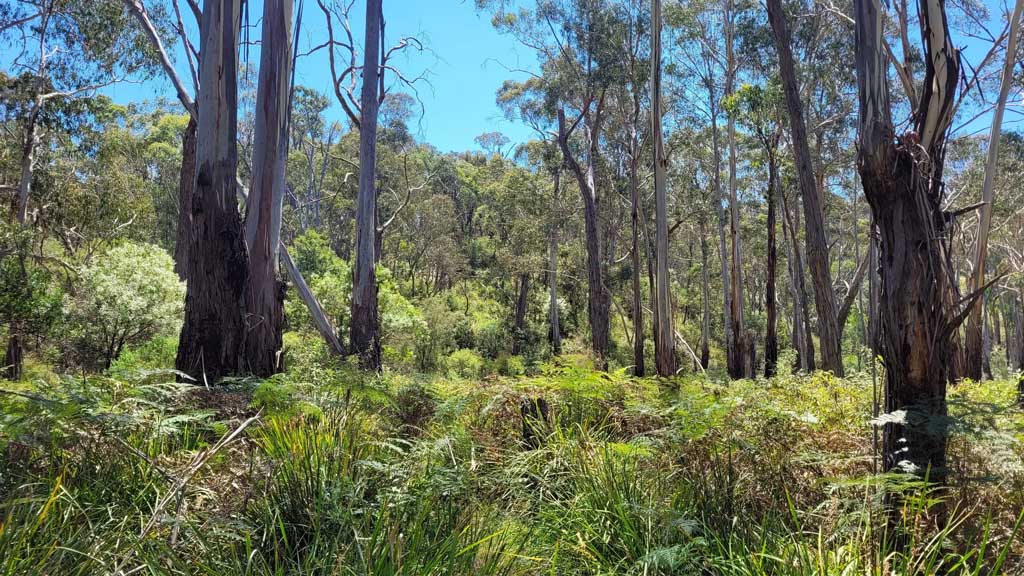


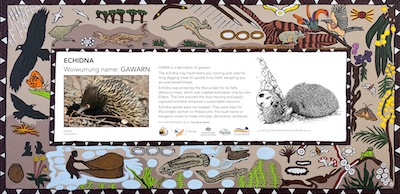
Named after the Echidna found throughout this area, Gawa Reserve is a relatively intact Riparian Forest of high regional significance. It also offers you a burra burra yan, a bush walk of discovery through Wurundjeri country.
This reserve features the Gawa Wurundjeri Resource Trail, designed to provide visitors with a deeper understanding of how the Wurundjeri people used the land to provide themselves with food, medicines, implements,shelters and the clothes they wore – all seen as created for their enjoyment and use by their Dreamtime spirits.
For much of the year Watsons Creek is merely a trickle, at other times it flows freely. The creek originates in the forested Kinglake National Park and quickly passes into cleared land at Christmas Hills and Kangaroo Ground. It enters the Yarra River from the north near Wonga Park.
History of the area
Before the arrival of Europeans, Wurundjeri people lived in harmony with these bush and hills. Rich in natural resources, this land sustained them for more than 40,000 years because their lore ensured sustainable care of the country. Throughout the warmer months, they hunted and gathered along the Yarra then moved into the shelter of the hills when the weather grew colder.
Imagine this place before white settlers arrived: the land looked different because fire-stick farming methods encouraged open grassland between the trees. Wurundjeri men, women and children would have camped right here on Watsons Creek. Throughout their lives they’d depended upon its resources for their every need. They’d learnt everything there was to be learnt about their home country’s plants and animals. Wurundjeri lore and all knowledge were taught through stories and observation
In 1840 the land on this southern side of Watsons Creek was claimed as part of James Murray’s Watsons Creek Station. In 1854 gold was discovered in the streams flowing into Watsons Creek and this saw hundreds of diggers crowd in, drastically changing the landscape and its natural resources, and making it difficult for Wurundjeri people to continue their connection to this place and their ways of life.
Farming, mining and timber cutting continued in the general area well into the twentieth century. There are still some remnants of occupation along the Watsons Creek from the 1960s and 70s that heralded the new wave of people escaping from the city to come to live in the area.
This site is now jointly managed by Nillumbik Shire Council and Parks Victoria, who have kindly permitted the Nillumbik Reconciliation Group to construct the walking trail.
The Gawa Wurundjeri Resource Trail
The Trail was launched by Wurundjeri elder Jim Wandin and the Nillumbik Reconciliation Group in partnership with the Nillumbik Shire Council on the afternoon of 12 August 2001. A scar tree of recent creation is located within the Gawa Reserve, carved by Wurundjeri ngurungaeta Jim Wandin before the launch of the trail.
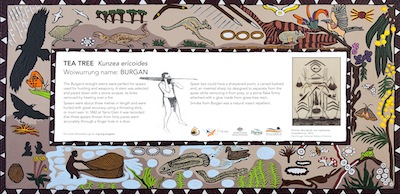
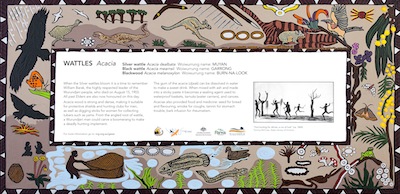
Markers explain how the Wurundjeri clan lived near the creek and used the land to obtain bush foods, medicines, implements, shelter and clothes. The trail introduces visitors to the indigenous flora and fauna, including manna gums, Lomandra (used to weave baskets) and wombat burrows.
New markers were added in 2017 with artwork by Wurundjeri artist Judy Nicholson, a descendent of William Barak.





Walking the trail
The 340m self-guided walking trail consists of a main trail with a loop. The main track leads to a lookout over Watsons Creek. The self-guided trail and loop, and takes you through the diverse and interesting vegetation of the Gawa Reserve. It is designed to be walked in a clockwise direction with signs detailing how the Wurundjeri people utilise the bushland resources.
To help preserve this area visitors are reminded to:
- Stay on the walking track at all times
- Do not collect, remove or damage any plants as they are protected
- Keep dogs on a leash at all times
- Take all rubbish home
Self-guided Tour

Self-guided tours are available by following the 11 plaques that weave throughout this unique environment. The plaques tell the story of the Wurundjeri clan of about 50 people who lived near Watsons Creek. Take your time to imagine this place before white settlers arrived.
- Imagine how different the land looked with fire-stick farming methods being used to encourage open grassland between the trees.
- Imagine the Wurundjeri men, women and children camping here on the banks of Watsons Creek.
- Imagine a time when everything you needed to survive was provided by the land. A time when knowledge was shared and taught through Wurundjeri lore by stories and observations.
Part of the Panton Hill Bushland Reserves System
Gawa Reserve is part of the Panton Hill Bushland Reserves System, a set of seven bushland reserves owned and managed by Nillumbik Shire Council in association with Parks Victoria. They form a 140 hectare corridor of relatively intact remnant bushland extending from Smiths Gully in the North to Watson’s Creek in the South. They include an extensive network of walking trails and are significant for their presence of heritage sites and diverse array of native plants, animals and vegetation.
The individual reserves are named using Wurrundjeri names for species found in the Reserves: Bulwidj (Yellow Box), Bunjil (Wedge-tailed Eagle), Gawa (Echidna), Wimbi (Swamp Wallaby), Wurran (Sugar Glider), Yanggai (Yellow-tailed Black Cockatoo), and Yirrip (Ironbark). Learn more about the Panton Hill Bushland Reserve System.
Connect
Events, workshops, and volunteer & support activities related to this site:
- Panton Hill Bushland Reserves System User Group: For information, or to get involved, please contact Brad Tadday, Senior Environmental Works Officer, Nillumbik Shire Council on 9433 3203 or email Brad.Tadday@nillumbik.vic.gov.au
- Volunteer activities are held regularly within the reserves and include a range of works such as weed control, trail maintenance, flora and fauna monitoring, pest animal management, trail monitoring, revegetation and rubbish removal.
- NRG conducts school group tours of the Trail which provide an understanding of the Wurundjeri culture, lifestyle and their use of local fauna and flora. Tours can be booked by contacting NRG.