The Darrabi Aboriginal Food and Reconciliation Garden was opened in May 2007 as a joint initiative of Nillumbik Reconciliation Group, Hurstbridge Primary School and Nillumbik Shire Council.
Darrabi is a Wurundjeri word for “awaken”. The garden is designed as an educational resource for children and visitors, and its layout reflects the ‘six seasons’ of the Middle Yarra Timelines Calendar: Early Spring, True Spring, High Summer, Late Summer, Early Winter and Deep Winter. Five hundred children from Hurstbridge Primary School have helped place a native plant in Darrabi’s ‘six seasons’ garden.
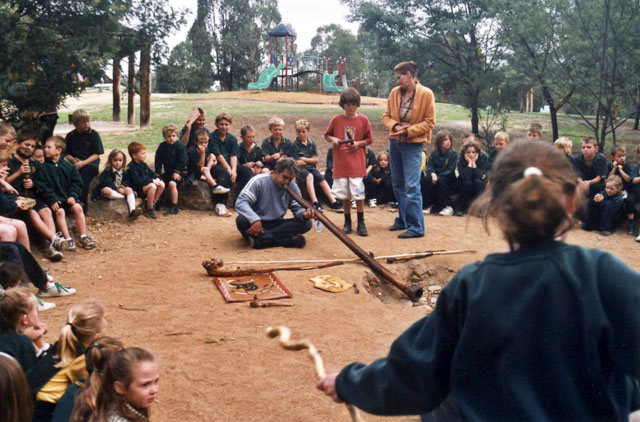
The garden displays a wide range of native species used by Aborigines for food, medicine, implements, shelter and clothes. It also features a 20m circle of rock seats around a fire pit, and provides a unique gathering space which is available for outdoor education, Indigenous ceremonies or for other community groups to explore the rich cultural history of Indigenous Australia and the diversity and usefulness of our Australian native plants.
The garden is maintained by the Friends of Darrabi and is located on Council land in Ferguson’s Paddock, which is beside Hurstbridge Primary School and adjacent to the Diamond Creek. It is surrounded by bushwalking trails, playgrounds and open public space. (Melway 263:A7)
You can download a brochure about the garden here (240KB); for a species list or more information, please contact Hurstbridge Primary School on 9718 2386.
A Unique Public Space
The Darrabi Garden is a unique community asset, conveniently located in Ferguson’s Paddock beside Hurstbridge Primary School. Adjacent to the Diamond Creek and surrounded by bushwalking trails, playgrounds and public open space, Darrabi provides an ideal learning environment for schools, community groups, and anyone with an interest in Reconciliation, health, art and culture, the environment, or tourism.
Darrabi Means “Awaken”
Nillumbik Reconciliation Group and parents and teachers of Hurstbridge Primary School created the garden to help ‘awaken’ and educate children and visitors to the wisdom of Indigenous culture, and the untapped usefulness of our native plants.
Welcome to Wurundjeri Land
Darrabi was opened on Sorry Day, May 2007, with a symbolic ‘Sea of Hands’ and a smoking ceremony by Wurundjeri Elder Kim Wandin and Nillumbik Reconciliation Group’s Yorta Yorta Elder Pam Pedersen.
Connected to Country
For thousands of years, Aborigines lived in harmony with the land and depended upon its seasonal resources for their physical and spiritual survival. They were happy, healthy, and organized people with an intimate knowledge and respect for the native plants and animals they relied on. They thoughtfully hunted and gathered food along the Yarra Valley to ensure the long-term health of their environment. Their tribal lands provided all their needs. They used native plants for food, drinks, medicines, fibre, clothing, shelter, shields, tools, transport, containers, art, toys, adornment, and musical instruments.
Six Seasons of the Middle Yarra
Aborigines understood the seasons differently from us. While we imported four seasons from Europe, applying them broadly across different regions, this approach does not align well with the local environment. Recent studies by Australian botanists and biologists have identified six seasonal changes in the Yarra Valley that better reflect the local climate and ecology. Darrabi’s design emphasizes these six seasons through a 30-meter circle with six segments radiating from a central plaque and diagram. Outdoor Classroom Schools and community groups will find the large rock circle or ‘outdoor classroom’ with its earth fire pit particularly engaging and useful for educational activities.
Hidden Wisdom
Time spent in thought and exploration at Darrabi Garden helps us develop a deeper understanding of the richness of Aboriginal culture and their harmonious movement with the seasons, cultivating and conserving the natural environment. There is great hidden wisdom in Indigenous knowledge. By embracing this wisdom, we build bridges of reconciliation towards an authentic Australian culture for future generations.
Learning with Nature
Take time out to ‘go wild’ or ‘go bush’ in the Green Wedge; it’s free, fresh, and fun. Children, and the young at heart, thrive in nature, and Darrabi provides a gathering place for meaningful hands-on learning about Australia’s remarkable biodiversity. Only by learning from ancient Indigenous practices—consuming less and conserving more—can we live in harmony with this land and sustain its future.
Useful or Edible Plants
Hurstbridge and Diamond Creek are home to many native and Indigenous plants. Darrabi features over 500 native plants, including 120 different species known to be used by Aborigines throughout Australia.
For further information or to participate in planting days and events, please contact:
Friends of Darrabi
PO Box 394, Panton Hill, VIC 3759
Convenor: Susie Walker
Phone: (03) 9719 7170
More information: http://www.wikinorthia.net.au/friends-of-darrabi-aboriginal-native-food-garden/